

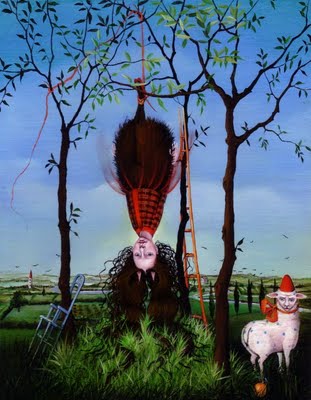
	Snow White, Rose Red
		After Anne Sexton

	No matter what life you lead
	the body is an engine
	that must be fed;
	caviar or beetroot, the inner
	furnace stoked.

	There are other hungers,
	in a village of immigrants:
	empty bellies, like brown dogs,
	are everywhere.
            	But there is a cost.

And so there were two girls, not yet 18,
hair thick as hemp. One dark as a gallows bird.
One pale as a turnip. Let us call them
Snow White and Rose Red,
They were good girls both, with bellies
like empty cauldrons slung beneath their ribs,
and families to feed: Mama, Papa, siblings galore.
They loved one another like sisters.

Two kings as well.
The first big as a farmboy with cheeks
like slabs of mutton. The second small
as an afterthought, sharp as a straight razor.
They prospered like a younger son in Grimm.
Perhaps there was spellwork involved. Something
dark and chthonic. Perhaps not.
Either way, with their complementary talents,
their preference for goose liver,
and truffles, they agreed to share
a kingdom, draping themselves in fur and honey.

	Dear reader,
	this is a story of hungers.

Our two maidens applied to work in the castle
where, word on the street, (which always knows
the way the wind is blowing) said hundreds of girls
toiled toward their beds of  roses,
each as clean as an egg, sweet as a lamb.
And so it was. Day and night, these good girls
plied scissors and needle, side by side. Beautiful
clothes spilled from their hands. Seven days
a week, they toiled in coffin-shaped towers; fourteen

hours a day. Sundays, rather than coin
they were given a slice of pie; American as apple.
Every day, the kings’ servants, those frogmarchers,
those boot lickers, winked at one another
and promised the girls a gleaming future:
bellies full as State Fairs, rags to riches, indoor
plumbing. The castle teemed. Girls stitched
like Singers, set sleeves, hems, cuffs. Pleated,
ruched, and cut. Rooms filled
with frills and furbelows, lustre
and ponge and silk.

	Soon, the kings, pink
	as pigs in their velvet collars and monocles,
	began to worry. All those snips and scraps
	might be thieved. They believed everyone
	wore greed like a birthday suit. Those kings bridled
	at the thought of losing so much as a tail
	of thread, an inch of lace.

All day long, the doors were bolt-shot
tight as a coin purse.
Eventide, every girl must be searched,
all their nooks and crannies.
Every pocket well-fingered.

Somewhere inside the castle
a man hungered for a cigarette,
tobacco-fat to quiet his lean gut. And,
as we all do, he gave in to the ache and gnaw:
thumbed a match to flame, drew in
the sweet heat. But the flame, like the engine
of commerce, like the dumbbeast bellies,
like the kings with  their pampered skin,
their porkpie hats, hungered.

	The uninvited guest refused
	to be put out, instead slid crackling
	fingers into heaps and stacks, furtive
	at first, then bolder. Ravenous it feasted:
	lapping paper patterns, cotton bolts,
	devouring, pushing everything it could
	into its hot raw mouth with fiery hands.
	It played hunger’s savage tune
	until the workers do-si-doed. Did the Lindy,
	O how they jigged and twisted to its hot licks.

High in their counting rooms, where even the walls
greased gold, the kings told of the trollish trespasser,
its gobbling, heathenish gluttony, fretted.
They perspired, their moist mouths
opening and closing like fish. Their servants came
to gently mop their brows,
to lovingly pat their hands,
to tenderly lead them to safety.
Below, girls were screaming. Smoke-choked.
Doors were still locked.
Stairways blocked. Windows yawned
90 feet above the ground.

Our heroines saw the flames.
Saw their friends leap from windows,
cartwheeling toward death. Skirts ballooning.
Legs churning as though to find
footing on air. Like Wyle E Coyote running
off a cliff, almost cartoon humorous.
Almost slapstick. Until they hit.

	Snow White and Rose Red clung
	to each other. Their cheeks— blistering.
	Their hair burnt away. They wore gowns
	of flame. They were almost beautiful
	in their immolation, bright as gold
	as they burned.

Later, those who cleaned the mess away
found the girls entwined, melted together.
So charred, whether male or female,
could not be determined. Only that once
the remains were human.
As for the kings, they fretted
over their sooted ledgers. Spoiled cloth.
Their blackened tower.

All the work— undone.
Once more, they sent their servants
into villages of beet soup and black bread.
Once more, they hired immigrant girls
to sew.

	bone pyre of the poor.
	rendering of appetite.
	146 dead.
	A kind of math.
            	A sort of burnt offering.


In 1911, the Triangle Shirtwaist Factory, owned by obscenely wealthy businessmen Blanck and Harris, ignited, resulting in the deaths of 146 workers, most of whom were teenage girls who were impoverished Austro-European Jewish immigrants. Many young women leapt to their deaths, their hair and gowns on fire, while the rest, still trapped on the ninth floor, burned to death. Within months, the owners hired new workers and reopened.

				*first line borrowed
				From  Anne Sexton’s
				Snow White and the Seven Dwarfs
What Inspires You
I am deeply interested in history, particularly the stories of women such as those at the Triangle Shirtwaist Factory, the Radium Girls, and the Babushkas who still live in the Chernobyl Exclusion Zone. I also find inspiration in poets like Aracelis Girmay, Diane Seuss, Jane Setterfield, Ocean Vuong, and Anne Carson. As an autodidact, I have become a voracious reader, especially of poetry, exploring works from both classic masters and contemporary voices.
I enjoy reading biographies of notable figures, including Marie Curie, Virginia Woolf, Charles Dickens, Emily Dickinson, Jane Austen, John Keats, Mary Shelley, Leonardo da Vinci, Vincent van Gogh, Nikola Tesla, Peter the Great, Annie Oakley, and many others. I love art, especially the surrealists. One of my favorite contemporary artists is the figurative painter Heather Nevay, from Glasgow. I constantly draw inspiration from those who have found unique ways to express their voices, creativity, and souls.
Bio
Kim Welliver is an autodidact writer living in Utah. Her work has appeared in the Bellevue Literary Review, Mid-American Review, West Trade Review, and Fairy Tale Review, among others. She is a two-time Pushcart Prize and Best of the Net nominee and has twice been double awarded first and second places in the Utah Arts Council Original Writing Competition. Informed by over twenty years of intensive caregiving, her poetry often explores the intersection of the biological and the ethereal.